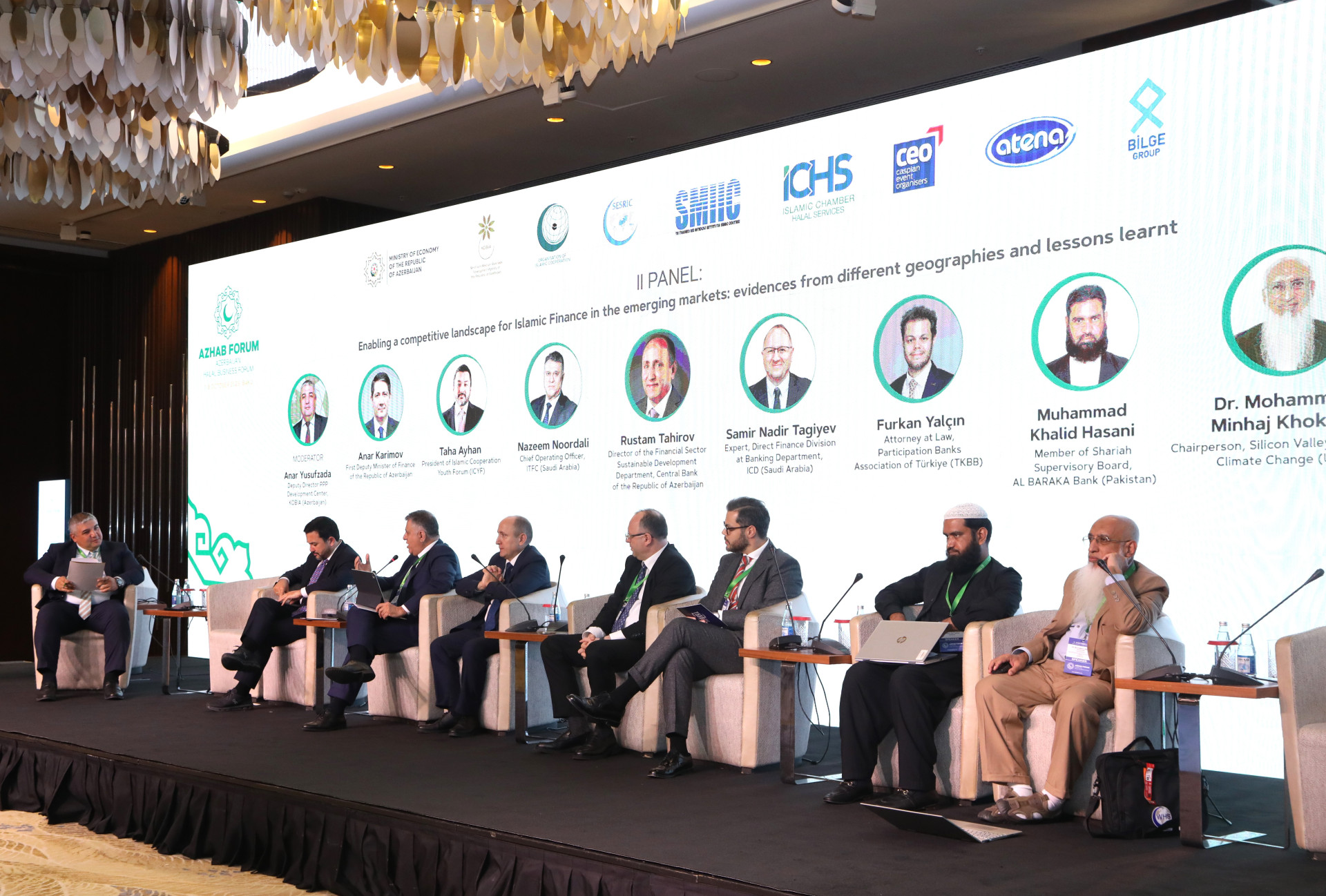
The AZHAB Forum served as a platform for panel discussions on a wide range of subjects.
The Azerbaijan Halal Business Forum (AZHAB Forum), held in Baku on October 7–8, featured panel discussions on topics such as SME support, Islamic finance, halal business management, the green transition of SMEs, halal tourism, and the contribution of women to the development of the halal industry.
Representatives from the Ministry of Finance of the Republic of Azerbaijan, the Central Bank, the International Islamic Trade Finance Corporation (ITFC), the Islamic Corporation for the Development of the Private Sector (ICD), the Turkish Participation Banks Association (TKBB), Al Baraka Bank, the Islamic Cooperation Youth Forum (ICYF), and the Silicon Valley Climate Change Institute participated in the panel discussion held on the first day of the event under the theme “Creating a Competitive Environment for Islamic Finance in Emerging Markets: Experiences from Different Regions and Lessons Learned.” In addition to reviewing the experience of implementing Islamic banking in various countries, discussions focused on the competitive landscape of Islamic finance, financial technologies, and infrastructure development.
With the participation of the Supreme Council for Islamic Affairs of Nigeria, SMIIC, the Halal Development Corporation of Malaysia, the Muslim Insider Chamber of Commerce, the Africa Institute of Global Studies University, Navigating Transformation Women’s Entrepreneurship Consulting, and business representatives, the panel “Halal Business Management: Harmony of Success or Success of Harmony” addressed issues related to Islamic and traditional business management.
The panel titled “Promotion of Cooperation among Institutions Supporting SMEs within the Framework of the Organization of Islamic Cooperation (OIC): The First Meeting of the OIC SME Network” was dedicated to the founding session and inaugural meeting of the OIC SME Network. The meeting brought together representatives of institutions and agencies from OIC member states that provide support and services to small and medium-sized enterprises (SMEs). The main goal of establishing the Network is to strengthen cooperation among SME-supporting organizations within the OIC framework. During the session, representatives from SME-related institutions in OIC member countries delivered presentations, sharing their national experiences, institutional practices, and opportunities for cooperation in SME support and service provision. The event was attended by representatives of Turkey’s KOSGEB, Saudi Arabia’s MONSHAAT, Morocco’s “Morocco PME,” and the relevant agencies of Jordan, Pakistan, Kyrgyzstan, Chad, and Côte d’Ivoire. The Small and Medium Business Development Agency (KOBIA) of Azerbaijan presented information on SME support and services in Azerbaijan, as well as on the national SME ecosystem. Speakers emphasized that SMEs are the driving force of the global economy, playing a crucial role in economic growth and employment. It was noted that in OIC member countries, SMEs constitute 99.9% of all enterprises, employ over 93% of the workforce, and contribute approximately 85% to value added. At the conclusion of the founding assembly of the OIC SME Network, the Baku Declaration was adopted. The Declaration expresses gratitude to Azerbaijan for hosting the inaugural meeting and for its consistent support of regional cooperation in SME development. Furthermore, it was decided that the chairmanship of the OIC SME Network will be held by KOBIA for a term of three years, while the Statistical, Economic and Social Research and Training Centre for Islamic Countries (SESRIC) will serve as the Secretariat of the Network.
One of the main topics of the AZHAB Forum 2025 was the green transition of SMEs. On the second day of the forum, a panel discussion titled “Enhancing the Role of SMEs in the Global Green Transition: Baku Climate Declaration for the Green Transition of SMEs” featured representatives from the Asian Development Bank, Kazakhstan’s “Damu” Entrepreneurship Development Fund, the National Entrepreneurship Association of Vietnam, Turkey’s Bilisim Valley Technology Zone, the United Kingdom’s “Sustainable Cities Global Ltd,” Pakistan’s Standards and Quality Control Organization, and Indonesia’s Institute of Food, Drug, and Cosmetics Evaluation.
Participants exchanged views on the role of SMEs in the economy, environmentally responsible production, efficient use of resources, the environmental impact of SMEs, and the importance and action plan of the Baku Climate Declaration. It should be noted that KOBIA proposed the Baku Climate Declaration during COP29. To date, over 20 domestic and international organizations have joined the document.
Representatives from the Organization of Turkic States, the Halal Travel Guide, the Caucasus History Center, the UMAI International Laboratory, the Gambian Institute of Travel and Tourism, the Turkic World Research Center, and Spain’s Las Fuentes Foundation participated in the panel “The Role of Historical Heritage in the Development of Halal Tourism in the Caucasus and Central Asia.”
Discussions focused on how the region’s rich cultural heritage and hospitality traditions can be combined with opportunities in the halal tourism industry and how the historical heritage of the Caucasus and Central Asia can be leveraged to develop halal tourism.
The Spanish Las Fuentes Foundation, the publication “Musulmans en France,” the Azerbaijan Women’s Entrepreneurship Development Association (AQSIA), the Women’s Economic Empowerment Organization, the ZIRA Natural & Gourmet brand, the Global Oracle Leaders Association, the United Kingdom’s Sustainable Cities Global Ltd, and academic representatives took part in the panel discussion “The Role of Women in the Development of the Halal Industry.”
Discussions centered on encouraging women’s involvement in all aspects of the halal industry and highlighting the contributions of female entrepreneurs to its growth. The participating women entrepreneurs also shared their success stories.
Note: The 2nd AZHAB Forum, held under the theme “Halal Industry as a Source of Resilience in a Rapidly Changing World,” was organized with the support of the Ministry of Economy of the Republic of Azerbaijan and the Small and Medium Business Development Agency (KOBIA). The event was held in partnership with the Organization of Islamic Cooperation (OIC), the Statistical, Economic and Social Research and Training Centre for Islamic Countries (SESRIC), the Standards and Metrology Institute for Islamic Countries (SMIIC), the Islamic Chamber of Commerce Halal Services (ICHS), and Caspian Event Organisers LLC, with sponsorship from ATENA LLC and Bilgah Group.
Official representatives from over 30 countries attended the two-day event, along with participants from academic institutions, business associations, international organizations, and industry experts. They discussed a broad spectrum of topics, including trade and investment cooperation, access to global markets, the potential and emerging trends of the halal industry, and the role of innovation and technology in the certification of halal goods and services. In total, more than 500 participants attended the forum. In addition to B2B meetings designed to foster business networking and partnership opportunities, the event featured an exhibition showcasing the products and services of about 30 companies and business associations from Azerbaijan, Türkiye, Pakistan, Uzbekistan, and Kyrgyzstan.
Certificates were also presented to volunteers in recognition of their contribution to organizing the AZHAB Forum.
 AZ
AZ
 EN
EN
 RU
RU